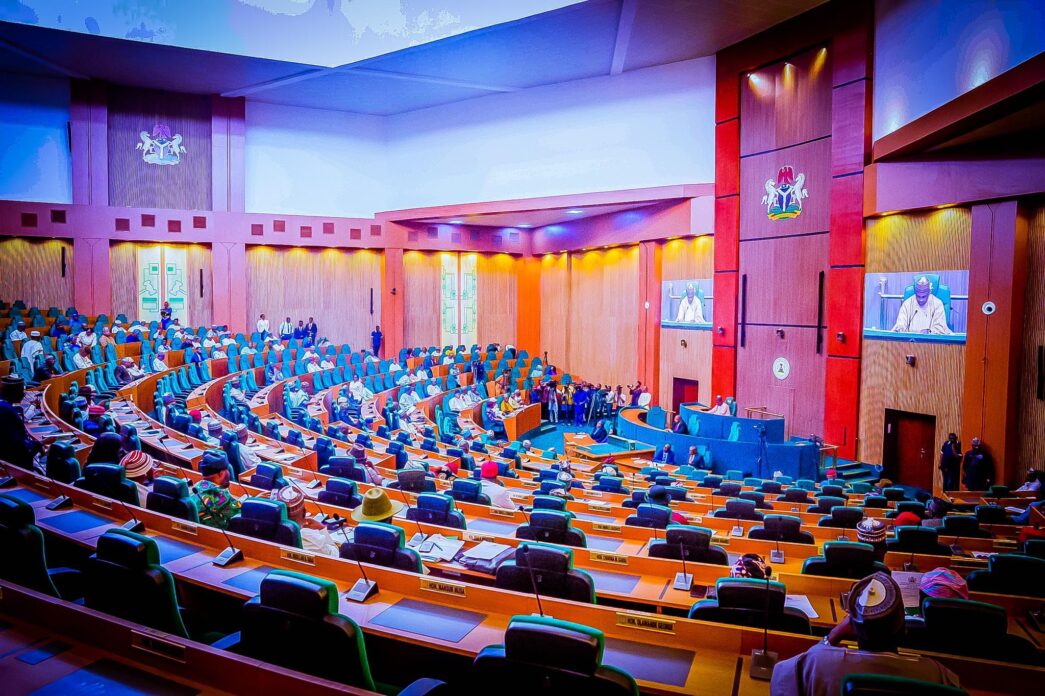

The House of Representatives has approved President Bola Tinubu’s proposed tax reform legislation for a second reading.
Following a protracted debate on the House floor, the legislation were passed for second reading.
The Nigerian tax system is intended to be overhauled by the four tax reform bills: the Nigeria Revenue Service (Establishment) Bill 2024, the Nigeria Tax Administration Bill 2024, the Nigeria Tax Bill 2024, and the Joint Revenue Board of Nigeria, Establishment Bill 2024.
Despite strong opposition, Tinubu presented the proposals to the National Assembly in 2024.
The majority leader, Julius Ihonvbere, addressed the worries expressed regarding the bills during Wednesday’s discussion, pointing out that the Nigerian Governors Forum, or NGF, had addressed the problems.
According to Ihonvbere, the House had met with various caucuses on multiple occasions to discuss their issues.
He also outlined some of the measures’ advantages, such as low-income earners’ tax breaks.
Speaker Abbas Tajudeen then put the bill to a vote, and after more than four hours of debate, it was approved for a second reading.
Later, the House Committee on Finance was tasked with taking additional legislative action on the legislation.
The Presidential Committee on Tax Reforms and Fiscal Policy produced the tax reform proposals with the intention of revising Nigeria’s current tax legislation.
But there has been strong opposition to the laws, mostly from the country’s northern regions, especially from northern governors who have called them “anti-North.”
It’s important to remember that Nigeria already has some promising prospects in the field of artificial intelligence, such as Awarri Technologies, with whom the Federal Government is working to develop vital AI software infrastructure to address the demands of the local market that are specific to our arts and culture, languages, and society, among other things, and that have largely been neglected by the models that are currently in place. In collaboration with our National Centre for AI and Robotics, this comprises data collection systems and an LLM for Nigerian languages.
Our Renewed Hope Agenda, which prioritizes economic diversification through industrialization, digitization, and innovation, is perfectly aligned with our cooperation discussion with Google. Businesses would benefit from this, new opportunities will arise, and Nigeria will become a major role in the global economy.