
In an effort to stop the nation’s woods from being recklessly destroyed, the federal government has taken a significant step.
In order to guarantee Nigeria’s adherence to the EUDR—which prohibits deforestation—and to stimulate the country’s economy, the government, acting through the Ministry of Agriculture and Food Security, established the National Task Force (NTF) on the EUDR.
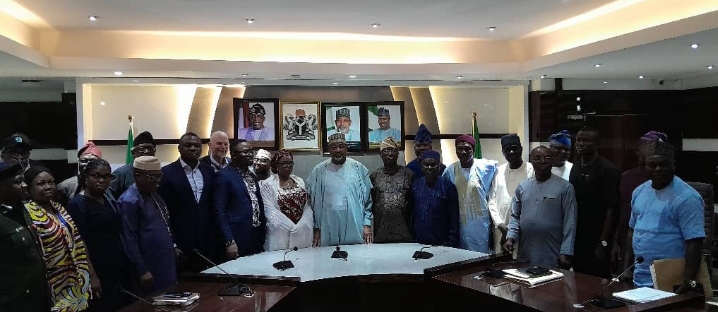
Sen. Abubakar Kyari, Minister of Agriculture and Food Security, who conducted the NTF inauguration, stated that it was a calculated move to address concerns in line with the EUDR.
Kyari continued, pointing out that the loss of biodiversity and climate change were directly caused by deforestation and forest degradation.
According to the Minister, the EUDR becomes operative on June 29, 2023, and compliance is required by December 2024.
He pointed out that the law targets commodities like lumber, soy, palm oil, coffee, cocoa, and cattle that are linked to high risks of deforestation, as well as products that are derived from them like chocolate, leather, tyres, and furniture.
Kyari emphasized that “only products that are legal under the domestic laws of the country of origin and are deforestation-free—that is, they have not contributed to deforestation or forest degradation after December 31, 2020—will be permitted in the EU market.”
The European Union (EU) is a significant trading partner, he said, and non-compliance with the EUDR would negatively affect Nigeria’s export markets for timber, soy, cocoa, and rubber, which make up 80%, 7%, and 5%, respectively, of the country’s 523 million Euro worth of exports to the EU.
In order to guarantee that additional nations abide by the EUDR’s standards, he so made a plea for an extension of the deadline.
He stated that “at the recently concluded meeting, the International Cocoa Organization (ICCO), which is made up of all the countries that produce cocoa, unequivocally called for a two-year postponement of the EUDR deadline.” Thus, I would want to take this occasion to support the request that the EUDR be suspended.
In order to guarantee deforestation-free products, Kyari also emphasized the significance of cooperation in the creation of a central national database for traceability and certification, as well as forest mapping and due diligence.
He mentioned the efforts made by Ghana to map 1.2 million farms and get ready to track cocoa beans from their origins to ships. He made it clear that Nigeria will not lag behind in terms of compliance.
In order to satisfy these criteria and protect Nigeria’s standing in the international market, the Minister asked the NTF to collaborate with partners from the public and private sectors.
The Federal Department of Agriculture’s Director, Engineer Abubakar Abdullahi, represented Permanent Secretary Temitope Peter Fashedemi in his welcome speech, and he said the Ministry would assist the NTF in carrying out its mission in accordance with the Renewed Hope Agenda in the Agriculture Sector.
The following are included in the Terms of Reference (ToR) of the National Task Force: coordinating with pertinent stakeholders to develop a national strategy for EUDR, Create the National Task Force on EUDR’s implementation and finance plan.
Reviewing and approving a state plan for execution across the country are among the others. Establish a thorough GIS infrastructure for the production of cocoa, the digitization and profiling of all participants in the value chain, and other aspects of traceability. Discuss potential deadline extensions with the EU, among other things.