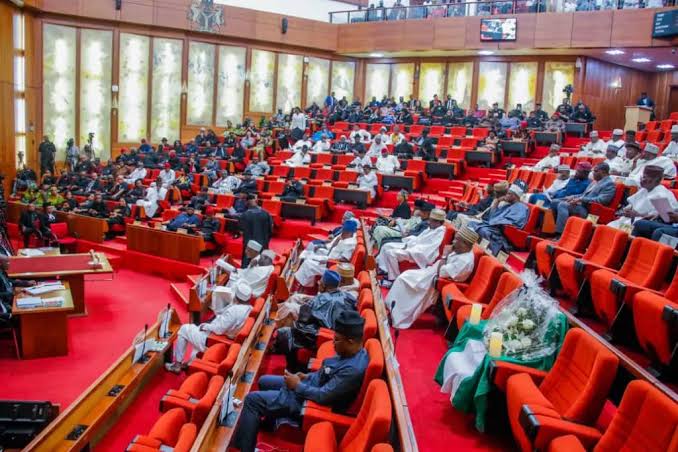

President Bola Tinubu’s contentious Tax Reform Bills were approved by the Nigerian Senate on Thursday for a second reading.
“A Bill for an Act to Establish the Joint Revenue Board, the Tax Appeal Tribunal, and the Office of the Tax Ombudsman, for the Harmonisation, Coordination, and Settlement of Disputes Arise from Revenue Administration in Nigeria and for Other Related Matters, 2024” is the title of the bill.
“A Bill for an Act to Repeal the Federal Inland Revenue Service (Establishment) Act, No. 13, 2007 and enact the Nigeria Revenue Service (Establishment) Act to Establish the Nigeria Revenue Service, charged with powers of assessment, collection, and accounting for revenue accruable to the Government of the Federation, and for related Matters, 2024.” A bill to enact legislation to provide for the evaluation,
collection of, and accounting for revenue accruing to the Federation, Federal, States and Local Government; prescribe the powers and funtions of tax authorities, and for related matters, 2024
A bill for an act to establish the powers and functions of tax authorities, provide for the assessment, collection, and accounting of money owed to the federal government, states, local governments, and the Federation, as well as for associated matters, 2024.
“A Bill for an Act to Repeal Certain Tax Acts and Consolidate the Legal Frameworks Associated with Taxation. Enact the Nigeria Tax Act to provide for the taxation of income, transactions, and instruments, and for related matters.”
Senate Majority Leader Bamidele Opeyemi, the bills’ sponsor, outlined the broad ideas, stating that if the legislation is approved, it will revolutionise tax administration in Nigeria and benefit Nigerians.
However, Senator Ali Ndume expressed doubts about the changes’ integrity, claiming that they go against some constitutional restrictions.
He maintained that in order to reflect the desire for tax reform, the 1999 Constitution as modified had to have been revised.
Ndume further mentioned how the National Executive Council, the Nigerian Governors’ Forum, traditional leaders, and other interested parties rejected the law.
He emphasised that the required actions should have been made to adhere to due process in accordance with legislative norms, but he did not say that he was opposed to the reforms because some of the elements were beneficial for the growth of a strong tax administration system in Nigeria.
Following Ndume’s speech and presentations by Seriake Dickson and Mohammed Ali Monguno, Senate President Godswill Akpabio
However, Senator Ali Ndume expressed doubts about the changes’ integrity, claiming that they go against some constitutional restrictions.
He maintained that in order to reflect the desire for tax reform, the 1999 Constitution as modified had to have been revised. Ndume further mentioned how the National Executive Council, the Nigerian Governors’ Forum, traditional leaders, and other interested parties rejected the law.
He emphasised that the required actions should have been made to adhere to due process in accordance with legislative norms, but he did not say that he was opposed to the reforms because some of the elements were beneficial for the growth of a strong tax administration system in Nigeria.