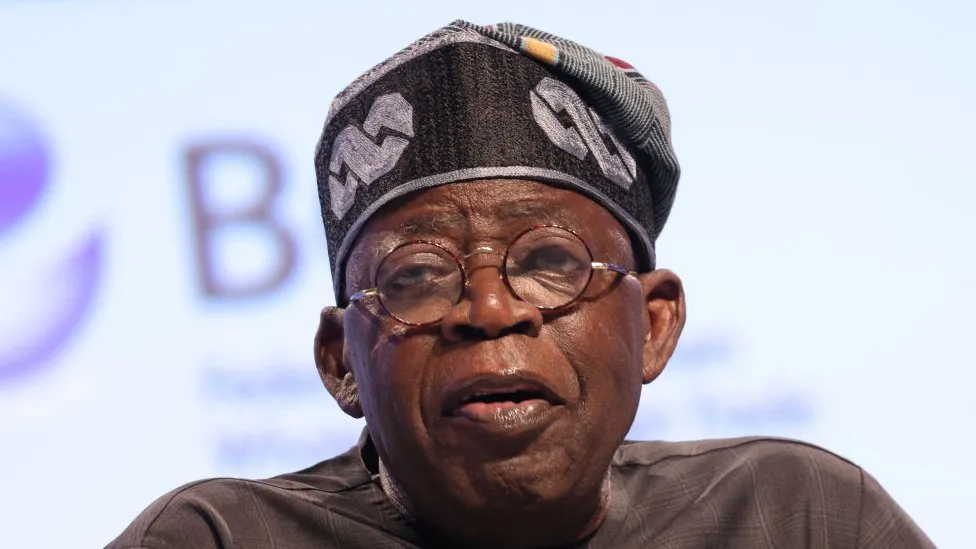

President Bola Tinubu asked the National Assembly on Tuesday, November 19, for permission to obtain a new $2.2 billion external loan.
This came after the borrowing plan was approved by the Federal Executive Council on November 10.
The president stated that the loan would be utilized to cover the N9.7 trillion budget shortfall for 2024.
“Request for the resolution of the National Assembly for the implementation of the new external borrowing of N1,767,102,179, which is approximately $2.209 billion already enshrined in the 2024 Appropriation Act,” was the section of the letter addressed to the National Assembly.
“I write the request for a resolution of the National Assembly to raise the sum of $2.2 09bn in accordance with the provisions of Sections 21 and 27 Subsection 1 of the Debt Management Office established Act 2003 and the approval of the Federal Executive Council.”
The budget was partially financed to around $9.17 trillion by the new foreign borrowing that was included in the 2024 Appropriations Act.
“Please accept the 2025–2027 MTF and FSP that were authorized at the November 10, 2024, Federal Executive Council meeting.
“The Senate is invited to observe that it is essential to seek the National Assembly’s swift legislative approval because the Federal Government of Nigeria’s 2025 budget will be prepared using the parameters and fiscal assumptions of the approved 2025-2027 MTF and FSP.”
Soon after the request was made public, Nigerians began to express concern, especially as the 2024 budget which the loan seeks to part-finance would be ending next month.
However, despite the concerns expressed by a vast majority of Nigerians, the National Assembly expeditiously, as requested by the President, gave its approval for the loan.
The approval came 48 hours after President Tinubu wrote to the two chambers of the National Assembly for a new foreign loan, which according to him, was already captured in the 2024 Appropriation Act.
The Senate at plenary received and considered the report of its Committee on Local and Foreign Debts, which was mandated to work on the President’s request.
The report was presented by the Chairman of the Committee, Aliyu Wammako (APC -Sokoto).
Presenting the committee’s report, Wammako had noted that the presidential request was very necessary for approval.
He said the loan request would be utilised for the execution of the ongoing projects and programmes in the 2024 Appropriation Act, stressing that the projects were critical for national growth and development.
“It will contribute to the implementation of the debt management strategy, which seeks to reduce the cost of borrowing. It will lengthen maturity of the public debt stock, free-up space in the domestic market for other borrowers and help increase Nigeria’s external reserves,” he said.
Wammako said Nigeria could raise all or part of the $2.2 billion through the issuance of Eurobonds in the International Capital Market (ICM).
The report was thereafter unanimously approved through an affirmative voice vote.
In his remarks after the approval, the Deputy Senate President, Jibrin Barau (APC-Kano), who presided over the plenary, commended the Wammako-led committee for a job well done.
After the presentation of the report, it was approved by senators, without dissent.
Similarly, the House of Representatives, also considered and approved the loan request following the presentation of the report by the House Committee on Aids, Loans and Debt Management, at plenary.
Reacting to the loan approval, former Vice President Atiku Abubakar, said it would exact unbearable negative pressure on the economy
Atiku, in a statement, said a recent report by World Bank, indicated that Nigeria is the third most indebted country to the International Development Association (IDA).
He expressed concern on the development, and blamed the National Assembly for being complicit in the debt which is already drowning the country.
The statement read: “The recent report released by the World Bank, showing Nigeria as the third most indebted country to the International Development Association (IDA), is very concerning.
“This report is coming just when the government has already sent a proposal to the National Assembly signaling an intention to borrow an additional N1.7 trillion being shortfall in the 2024 budget through Euro Bonds.
“What makes this particular loan proposal even more concerning is that it is benchmarked at the exchange rate of 1 USD to N800, whereas the current exchange rate from the Central Bank of Nigeria stands at over N1,600 to 1 USD.
“Nigeria is sinking further in debt, and the National Assembly has become an accomplice once more. Tinubu had, in July this year, boasted that the Federal Inland Revenue Service, FIRS, and the Customs under his watch have collected all-time high revenues to finance the budget. Why then are they still borrowing?
“There is something that they are not telling Nigerians, even as they are being crushed by a combination of their failed trial-and-error policies and loan rackets.
“These Tinubu’s loans are bone-crushing to Nigerians and bring insufferable pressure on the economy, especially when they are not properly negotiated and utilized.”
Atiku further argued that the unending penchant to borrow is borne out of greed and corruption and not necessarily because they want to develop the country’s infrastructure.
He continued: “It is concerning that the voracious appetite for these humongous loans is powered by corruption and not for infrastructure and development needs. A report by Budgit, a budget watchdog, has disclosed that the 2024 budget is a mess because of the level of pork associated with it.
“I feel a sense of personal agony seeing that just a few years after the administration of former President Olusegun Obasanjo took our country out of foreign indebtedness, we are today back at the top spot in the same conundrum. It is time that we apply more caution and arithmetic to the loan frenzy.”
Also reacting, president of the Middle Belt Forum, MBF, Dr Pogu Bitrus lamented that the external loans being procured by the country were not for any meaningful project but for consumption.
He said: “It is quite unfortunate that we are funding recurrent and unnecessary expenditures, not even capital projects, with loans, indebting generations yet unborn. It is quite unfortunate that Nigeria has found itself in this situation.”
He noted that “if the loan is for capital projects, Nigerians wouldn’t bother at all. But not when they are for consumption.
“After all the economic issues confronting Nigerians, it is unfortunate that we are still surviving on debts.”
“For example, if we have a project that is capital in nature, which will generate revenues for Nigeria, then we can say it is worth it but undefined terms like saying it is meant to complement; what are complementing?
“We are only getting Nigeria indebted and ruining the future of our country. These loans are not necessary,” he said.
He suggested that Nigeria should borrow a leaf from countries like India.
He said: “Nigerians just have to learn like the Indians did. At a stage, India even refused to import medicine, insisting that if Indians could not produce the medication required for her citizens, they should be left to die.
That’s how India made it through and is now one of the world’s developed countries. Therefore, it is regrettable that there are still people who believe that taking out loans on a regular basis is the best course of action; this mindset needs to change.
“Let’s make the most of what we have and expand our output until we can continue to exist and export.” That seems like the best course of action. Since taking out a loan would mortgage our children’s future, I no longer support it.
Maxi Okwu, a politician and lawyer, also denounced the development in his speech, stating that any rational Nigerian should be concerned about the nation’s growing debt load.
He questioned why the nation’s officials constantly turn to other nations or organizations for borrowing instead of managing the nation’s resources to build infrastructure.
The fact that the loans aren’t even for capital projects is the saddest part. They are only meant to be consumed.
It’s very regrettable. Again, I’m at a loss for words. The whole issue is as unfortunate as it is perplexing,” he remarked.